Accredited by :

Additional Menu
About the Journal
Policies
Template
Supporting Tools


Visitor Statistics

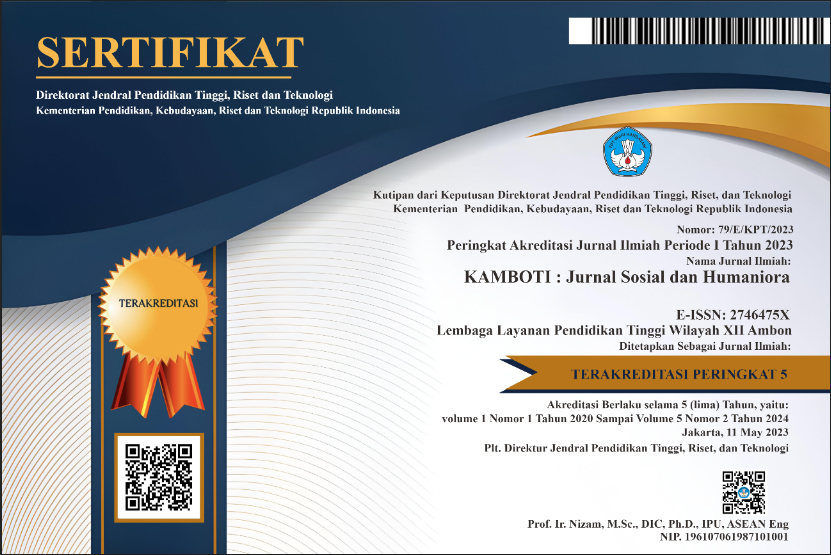
KAMBOTI: Jurnal Sosial dan Humaniora (ISSN 2746-4768; E-ISSN 2746-475X) is a peer-reviewed journal published by Lembaga Layanan Pendidikan Tinggi (LLDikti) Wilayah XII Ambon. This statement clarifies the ethical behavior of all parties involved in publishing an article in this journal, including the authors, the Editor-in-Chief, the Editorial Board, the peer reviewers, and the publisher. This statement is based on COPE's Best Practice Guidelines for Journal Editors.
Ethical Guideline for Journal Publication
The publication of an article in the peer-reviewed KAMBOTI: Jurnal Sosial dan Humaniora is an essential building block in the development of a coherent and respected network of knowledge. It is a direct reflection of the quality of the work of the authors and the institutions that support them. Peer-reviewed articles support and embody the scientific method. It is therefore essential to agree upon standards of expected ethical behavior for all parties involved in the act of publishing: the author, the journal editor, the peer reviewer, the publisher, and the society.
Lembaga Layanan Pendidikan Tinggi (LLDikti) Wilayah XII Ambon, as the publisher of KAMBOTI: Jurnal Sosial dan Humaniora, takes its duties of guardianship over all stages of publishing exceptionally seriously, and we recognize our ethical and other responsibilities. We are committed to ensuring that advertising, reprint, or other commercial revenue has no impact or influence on editorial decisions. In addition, LLDikti Wilayah XII Ambon and the Editorial Board will assist in communications with other journals and publishers where this is useful and necessary.
Publication Decisions
The Editor of KAMBOTI: Jurnal Sosial dan Humaniora is responsible for deciding which of the articles submitted to the journal should be published. The validation of the work in question and its importance to researchers and readers must always drive such decisions. The editors may be guided by the policies of the journal's Editorial Board and constrained by such legal requirements as shall then be in force regarding libel, copyright infringement, and plagiarism. The editors may confer with other editors or reviewers in making this decision.
Fair Play
An editor at any time evaluates manuscripts for their intellectual content without regard to race, gender, sexual orientation, religious belief, ethnic origin, citizenship, or political philosophy of the authors.
Confidentiality
The editor and any editorial staff must not disclose any information about a submitted manuscript to anyone other than the corresponding author, reviewers, potential reviewers, other editorial advisers, and the publisher, as appropriate.
KAMBOTI: Jurnal Sosial dan Humaniora requires all parties involved in the publication process (authors, reviewers, and editors) to disclose any conflict of interest that could influence, or be perceived to influence, their work.
Research misconduct includes, but is not limited to, fabrication, falsification, plagiarism, duplicate or redundant publication, manipulation of citations, and inappropriate authorship. KAMBOTI: Jurnal Sosial dan Humaniora takes all allegations of misconduct seriously and handles them in accordance with the guidelines and flowcharts of the Committee on Publication Ethics (COPE).
KAMBOTI: Jurnal Sosial dan Humaniora welcomes post-publication discussion of its published articles as part of the scholarly communication process. Readers who wish to comment on, raise questions about, or critique a published article may send their correspondence to the Editor-in-Chief via the journal's contact email, clearly stating the article title, author(s), volume, issue, and DOI.
The editors will review each submission. Constructive comments may be forwarded to the author(s) for a response and, where appropriate, published as a Letter to the Editor or Commentary together with the authors' reply. Comments that are offensive, defamatory, or irrelevant will not be considered. Where a comment reveals a significant error or ethical concern, it will be handled under the journal's policies on corrections, retractions, and research misconduct.
KAMBOTI: Jurnal Sosial dan Humaniora is committed to maintaining the integrity of the scholarly record. Once published, articles are not altered silently. Any changes are made transparently in accordance with the COPE Retraction Guidelines, through one of the following mechanisms:
All correction and retraction notices are published in a subsequent issue, linked to the original article, and include the article title, author(s), and DOI. Requests for correction or retraction from authors should be sent to the Editor-in-Chief with a clear explanation of the reasons.
Additional Menu
Template
Supporting Tools
Visitor Statistics